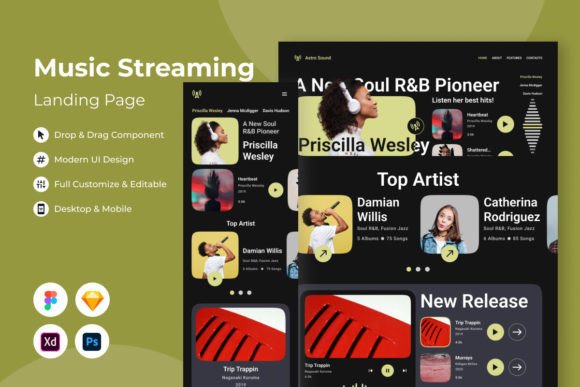
Astro Sound: A Modern Music Streaming Landing Page Template
For any entrepreneur, designer, or small business owner entering the competitive music streaming market, first impressions are everything. You have about three seconds to convince a visitor that your platform is worth their time, and a generic, slow-loading website simply won't cut it. This is where the Astro Sound template comes into play. It is not just a collection of static screens; it is a comprehensive design asset built specifically to bridge the gap between a great idea and a professional, market-ready product. By leveraging modern web design principles, Astro Sound offers a solution that feels both premium and accessible.
The Visual Language of Engagement
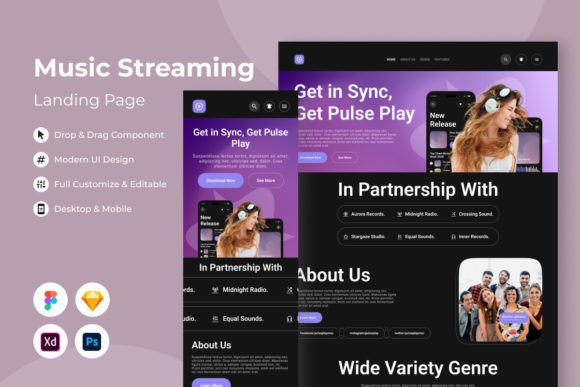
When you first look at the Astro Sound layout, the most striking feature is the deliberate use of negative space and dark-mode aesthetics. In the world of digital music, dark themes are not just a stylistic choice; they are functional. They reduce eye strain for users browsing late at night and, more importantly, they make album art and vibrant UI elements pop. The brand identity of Astro Sound relies heavily on this contrast. The template utilizes a modern typography approach, pairing clean sans serif font families for body text with more expressive display font styles for headers. This combination ensures that the text is legible while maintaining a high-energy, youthful vibe suitable for a music platform.
However, visual appeal goes beyond just colors and fonts. The layout of Astro Sound focuses on flow. It guides the user's eye from the "Hero" section—where the main value proposition lives—down to featured playlists and genre browsing. The interactive elements mentioned in the product description are key here. They mimic the actual behavior of a finished application. For a designer presenting this to a client, this means the design communicates not just what the app looks like, but how it feels to use. The layers are well-organized, which is a massive time-saver. Instead of digging through a chaotic file structure, you can quickly adjust global text styles or color palettes to match a specific client's needs, making it an excellent tool for rapid prototyping.
Practical Applications and Versatility
While Astro Sound is labeled as a music streaming landing page, its utility stretches far beyond that single niche. If you are a content creator or a podcaster, the structure of this template is ideal for showcasing your back catalog of episodes. The sections designed for "browsing genres" can easily be repurposed for "browsing topics" or "course modules." For entrepreneurs in the e-commerce space, particularly those selling digital goods like sample packs or sound effects, the grid layout provides a perfect framework for a digital storefront.
The file compatibility is another practical advantage worth noting. Whether you are most comfortable in Figma, Sketch, Adobe XD, or Photoshop, the Astro Sound files are ready to go. This flexibility is vital for collaborative teams. A graphic designer might prefer working in Photoshop for image manipulation, while a UI/UX specialist might stick to Figma for component management. Having a unified source file that works across these platforms ensures that the brand identity remains consistent, regardless of who is handling the specific design tasks. It removes the friction often associated with transferring files between different software environments.
Refining the User Experience
A landing page is only effective if it converts visitors into users. Astro Sound facilitates this through strategic placement of calls-to-action (CTAs) and social proof. The design accounts for the "Share" functionality, which is crucial for organic growth in the music industry. When a user finds a playlist they love, the ability to share it with friends needs to be intuitive. The template addresses this by placing interactive icons in thumb-friendly zones, particularly in the mobile version of the design.
It is also important to discuss the readability of the design. While the aesthetic is sleek, the template ensures that text remains legible against complex backgrounds. This is a common pitfall in music-related design, where busy album art can often drown out white text. Astro Sound solves this by using semi-transparent overlays or solid background containers for text elements, ensuring that the visual hierarchy is never compromised. For the end-user, this translates to a seamless experience where they don't have to squint to read a song title or a pricing plan.
Customization and Asset Management
One of the strongest selling points for designers is the organization of the file. We have all dealt with "design debt"—files where layers are named "Layer 1" or "Group 47." Astro Sound avoids this headache entirely. The use of open source fonts is also a significant benefit. It means you do not have to worry about licensing fees for the typography during the prototyping phase, and you can easily swap them out for premium commercial fonts later if the project budget allows.
When customizing this template, consider the psychology of your specific audience. If you are targeting a younger demographic interested in EDM or Hip Hop, you might want to increase the saturation of the accent colors and use a bolder, more geometric sans serif font. Conversely, if you are adapting this for a classical music streaming service or an audiobook platform, you might dial back the neon accents and introduce a more traditional serif font for the headers to evoke a sense of elegance and timelessness. The "Global text and color styles" feature makes these sweeping changes possible with just a few clicks.
Final Thoughts on Implementation
In summary, Astro Sound is more than just a pretty mockup; it is a functional tool for creative professionals. It acknowledges that the journey from concept to launch is fraught with revisions and pivots. By providing a clean, organized, and interactive foundation, it allows you to focus on the content and the strategy rather than wrestling with pixel alignment. Whether you are building a pitch deck for investors, creating a high-fidelity prototype for a client, or actually coding the frontend of a music service, this template provides the visual structure needed to succeed. It represents a solid investment in efficiency and quality for anyone serious about digital product design.